
First-Time Hair Topper Buying Guide
Your first hair topper should be chosen around four things: the size of the thinning area, the amount of coverage you want, the color and texture of your natural hair, and how you prefer to style and secure the piece. A beginner-friendly topper should cover the thinning zone while extending onto stronger surrounding hair, feel comfortable when clipped in, and blend naturally without forcing you into a complicated daily routine.
Quick Answer
Measure the visible thinning area front-to-back and side-to-side before choosing a base.
Select a base that extends beyond the thinning zone so clips can reach stronger hair.
Compare color, texture, density and length with the hair that will remain visible.
The topper should feel secure without painful pulling, pinching or repeated tension.

Step 1
Do You Need a Hair Topper or a Full Wig?
Hair Topper
Best suited to partial thinning at the part, crown or top of the head when you still have enough natural hair around the area for blending and attachment.
- Partial scalp coverage
- Your sides and back remain visible
- Usually lighter than a full wig
- Designed to blend with your existing hair
Full Wig
More appropriate when you need complete head coverage, have very limited natural hair for clips, or simply prefer full style replacement.
- Full head coverage
- Does not rely on blending with your own lengths
- Useful for more extensive hair loss
- Different attachment and fit considerations
Step 2
Measure the Thinning Area Before Choosing a Base
Use a soft measuring tape and measure the full visible thinning area. The goal is to choose a base that covers that zone and reaches stronger hair around the perimeter for more comfortable attachment.
Measure from where visible thinning begins toward the back of the crown.
Measure across the widest point of the thinning or visible scalp area.
Choose a base that extends beyond the thinning area onto stronger surrounding hair. The exact extra margin depends on your hair density and attachment points.
If you need frontal coverage, consider whether you want your natural hairline to remain visible or whether a lace-front or fringe design would be easier.
Step 3
Choose the Base Type That Matches Your Priorities
Mono / Mesh Bases
A fine mesh construction can offer breathability, flexible parting and a lightweight feel. It is a practical option for everyday wear and warm conditions.
Silk-Effect / Silk Bases
Layered silk constructions are designed to hide knots and create a scalp-like parting effect. They can be especially appealing when close-up part realism is a priority.
Step 4
Choose Density Based on Your Natural Hair, Not Just Maximum Volume
A topper should look like an extension of your own hair. Very high density can be useful for larger coverage needs, but it may look too heavy if your natural hair is fine. For first-time buyers, moderate density is often easier to blend than the fullest option.
Finer Natural Hair
Look for lighter or moderate density, softer layering and a base that does not overwhelm your perimeter hair.
Thicker Natural Hair
You may need more density or a larger base so the topper transitions naturally into the volume of your own sides and back.
Step 5
Match Color, Texture and Length Before You Buy
For the most natural result, compare the topper with the hair that will actually sit beside it. Natural daylight photos are usually more useful than indoor lighting for color matching.
Match the visible mid-lengths and ends, while also considering your root depth if the topper has a defined part.
Straight, wavy and curly toppers should complement your natural pattern so daily blending requires less heat styling.
Choose a length close to your own hair or plan to have the topper professionally trimmed for a softer transition.
Bangs, side fringe or lace-front designs can make the front transition easier depending on your hairline and styling preference.
Daily Wear
Clip Comfort Matters as Much as Appearance
Pressure clips should attach to stronger surrounding hair rather than repeatedly gripping the weakest thinning area. A topper should feel secure, but it should not cause sharp pulling, soreness or headaches.
Decision Guide
Beginner Hair Topper Selection Matrix
Use this as a starting point, then adjust according to your exact thinning pattern and natural hair density.
| Need | Typical Coverage | Good Starting Point | Feature to Prioritize |
|---|---|---|---|
| Small part-line thinning | Localized visible scalp | Small / narrow base | Lightweight construction and subtle density |
| Part + crown thinning | Moderate top coverage | Medium base | Comfortable perimeter clips and natural parting |
| Broader crown thinning | Wider top area | Larger base | Stable coverage with stronger anchor points |
| Hard-to-blend front | Front transition / hairline | Fringe or lace-front design | Easy front blending |
| Curly or wavy hair | Any suitable base size | Texture-matched topper | Less daily heat styling |
Different Picks for This Guide
6 Hair Toppers First-Time Buyers Can Explore
To keep this guide different from our other knowledge-hub articles, these recommendations focus on a wider mix of base sizes, textures, rooted shades, fringe options and construction styles.

Ombre Balayage Human Hair Topper with Bangs
Available in multiple base sizes with a mono construction, 130% density and built-in fringe for easier front blending.
View Product
5 × 6 in Mono Base Rooted Remy Topper
A larger mono-base option with rooted color choices for buyers who want broader crown coverage and a softer root transition.
View Product
Full Hand-Tied Curly Wavy Human Hair Topper
A 10 × 12 cm, 130% density option for buyers who want natural wave or curl without having to recreate texture every morning.
View Product
3 × 6 in Mono Base Virgin Remy Topper
A narrower 130% density mono option that can suit a more focused thinning pattern while still allowing flexible free parting.
View Product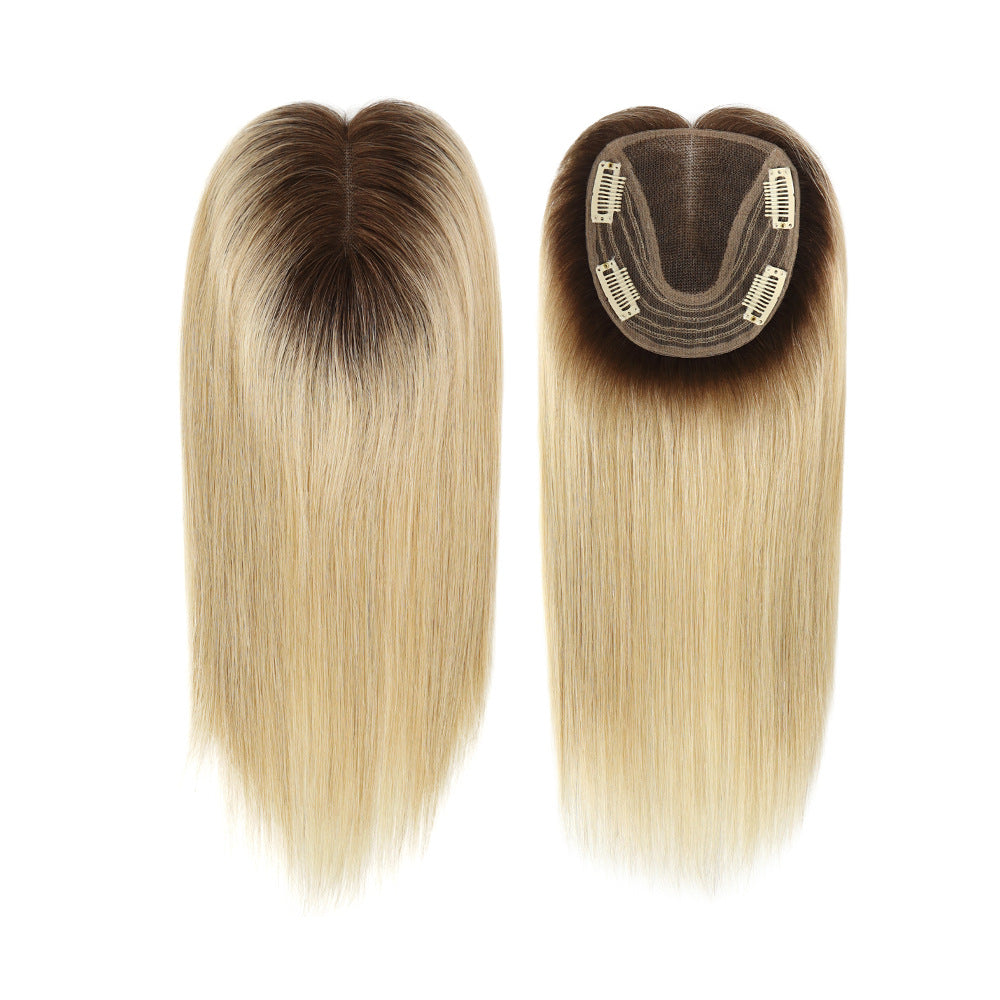
4.5 × 5 in Durable Lace Human Hair Topper
A breathable lace construction for shoppers who want moderate everyday coverage and a lighter-feeling base.
View Product
7 × 11 cm Silk Base Straight Human Hair Topper
A localized silk-base option with three pressure clips, designed for buyers prioritizing a scalp-like part and lighter coverage.
View ProductFAQ
Frequently Asked Questions for First-Time Hair Topper Buyers
Will topper clips damage my natural hair?
Clips can be comfortable when the base is correctly sized and the clips anchor into stronger surrounding hair. Avoid repeatedly clipping into fragile or actively thinning areas, and reposition the clips if you feel pulling or soreness.
Should I buy the smallest base possible?
Not necessarily. A base that is too small may place clips inside the thinning zone. Measure first and choose enough coverage to reach stronger anchor hair around the perimeter.
Are bangs easier for beginners?
They can be. A fringe can help conceal the front edge and reduce the amount of blending needed at the hairline, but it is still a style preference rather than a requirement.
How do I choose the right color online?
Use clear photos taken in natural daylight and compare the topper with your visible mid-lengths, ends and root depth. VivaCrown can also review your photos for color-matching guidance.
How long will a human hair topper last?
Lifespan varies widely with frequency of wear, washing, styling heat, products, storage and handling. There is no single lifespan that applies to every wearer or topper.
Need Help Choosing Your First Hair Topper?
Send clear natural-light photos of your crown, part line and hair color. VivaCrown can help you compare coverage, base size, texture and color before you order.
Hair toppers are cosmetic hair solutions. If a topper causes persistent pulling, pain or scalp irritation, stop wearing it and reassess the fit or attachment method.